Rethinking RTM:
From Operational Choice to Strategic Advantage
In the global consumer goods sector, competitive advantage depends not only on the product or the brand, but on how that product reaches the point of sale with efficiency, speed, and profitability. Route to Market (RTM) defines that structure.
Models such as van sales, pre-sales, hybrid schemes, and cross-dock are not interchangeable. Their performance depends on the economic context, channel structure, retail concentration, and product type.
Multinationals such as Nestlé, Procter & Gamble, and Grupo Bimbo operate with a range of models globally, and often multiple models within a single country. Over time, and through trial and error, they have learned to adapt their RTM models according to market needs, channel characteristics, and product nature, achieving a balance between efficiency and reach.
Main RTM Models
In general terms, RTM models can be divided based on the fragmentation or consolidation of deliveries, leading to Centralized Distribution (Direct to DC or Cross-dock), Direct Store Delivery (DSD), or third-party sales (wholesalers or distributors). This article focuses on DSD and Cross-dock models.
In Centralized Distribution, cross-dock operates through strategically selected regional or zonal points based on market density. These points act as intermediate warehouses. Suppliers deliver goods to these distribution centers, and the retailer then supplies its stores from them.
This brings logistical advantages for both supplier and retailer. Suppliers can deliver consolidated shipments by region, while retailers can distribute mixed loads (categories and suppliers) to stores on their own schedule. This allows greater operational stability, as retailers can plan routes and loads according to their own replenishment and demand needs.
On the other hand, DSD (Direct Store Delivery) involves delivering directly to stores. This can be implemented through different RTM sub-models such as van sales, pre-sales, and hybrid models.
Van sales combines selling and delivery in a single visit. Typically, a medium-sized truck follows a defined route and is restocked with a frequency ranging from daily to biweekly. The salesperson decides on-site what products and quantities to deliver based on immediate needs. Its main disadvantage is higher working capital and operational complexity, requiring strong route management and high commercial productivity to remain profitable.
Pre-sales separates order-taking from delivery. Orders can be captured in several ways:
A pre-sales agent visits the store days before delivery and agrees on product needs
The same salesperson/delivery driver captures the order during a delivery for the next visit
The customer places the order via a portal or customer service call
This model allows greater focus on market development during pre-sales. It also enables role specialization and reduces waste while improving freshness, as only requested products are delivered, minimizing rejections.
Hybrid models combine van sales and pre-sales. There are many variations, but a proven approach is to use van sales for developing categories with small inventory while pre-selling the rest of the portfolio.
Model Analysis by Market Type
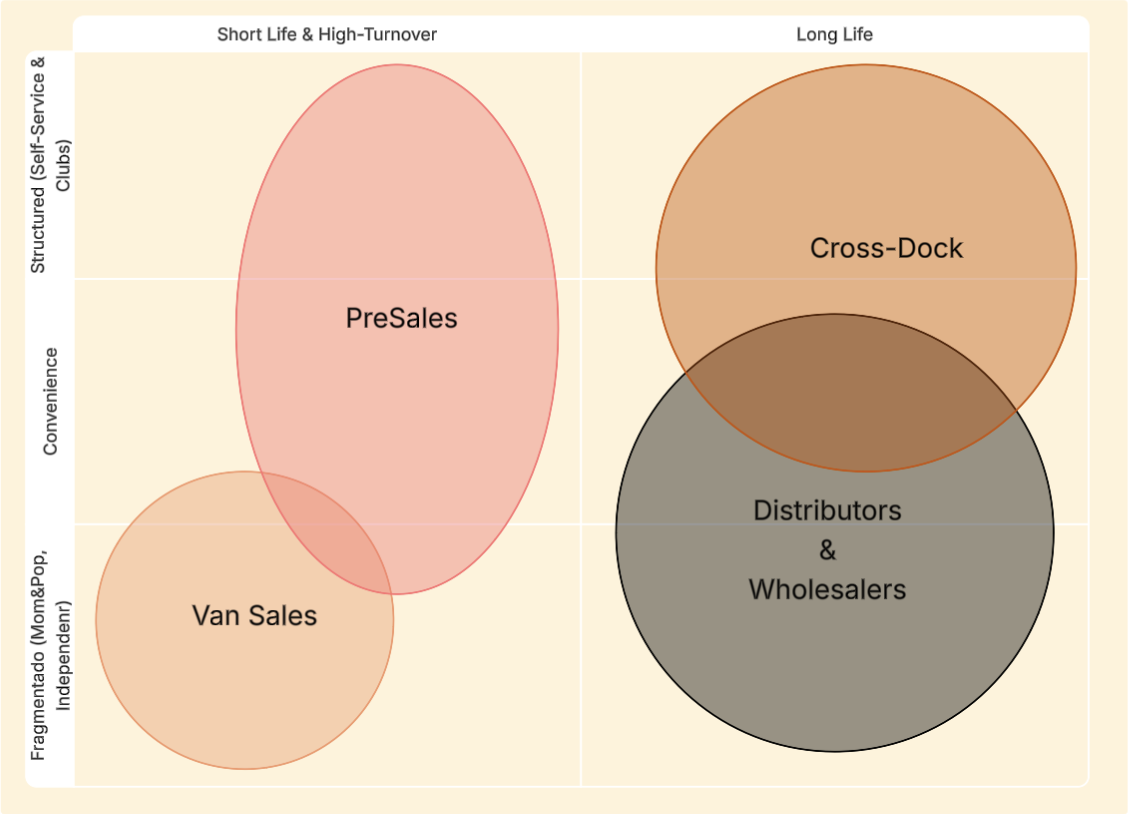
Cross-dock works best in structured markets such as supermarkets and warehouse clubs, where operations are highly standardized and purchase volumes per store are high and predictable. Centralizing inventory in distribution centers enables consolidation and transportation efficiency, reducing costs and improving planning for retailers.
A limitation of this model is reduced supplier control at store level. Since logistics are managed by the retailer, product replenishment and rotation depend more on internal retailer processes.
In contrast, fragmented markets—such as convenience stores, small groceries, and independent shops—have lower volumes, high geographic dispersion, and more variable purchasing patterns. In these cases, DSD models are more effective, as they allow closer interaction with stores, more frequent replenishment, and better adaptation to each store’s dynamics.
Within DSD, pre-sales works well in high-density areas with stable demand. It allows better route planning, optimized truck loading, and accurate fulfillment. It also enables commercial development, such as introducing new products and managing assortments more effectively.
Its limitation lies in the need for strong coordination between order capture and delivery, as well as accurate route and frequency planning.
Van sales is often used in environments with variable demand or where immediate replenishment is needed. The salesperson decides in real time what to deliver based on observed sales and store conditions, allowing dynamic assortment adjustments and closer store relationships.
However, this reduces predictability in logistics planning, making it harder to optimize loads and upstream inventory.
Model Analysis by Product Type
Beyond market type, product characteristics also influence RTM model selection. Factors such as shelf life and sales velocity determine which model ensures availability, freshness, and efficiency.
Short shelf-life products—such as fresh bread, dairy, or refrigerated goods—require frequent replenishment. Maintaining freshness is critical to avoid waste and ensure perceived quality.
Van sales is particularly effective here. By combining selling and delivery, the salesperson can adjust volumes continuously, remove near-expiry products, reduce overstock, and react quickly to demand changes. In fragmented markets, it also allows tighter control over store inventory.
Pre-sales also offers benefits for high-rotation products by ensuring accurate delivery quantities and reducing waste. It is especially recommended when developing a market or category.
High-rotation products require frequent replenishment. Both pre-sales and van sales can work, depending on channel type and demand stability. Pre-sales enables better planning, while van sales allows real-time reaction to demand fluctuations.
Low-rotation or long shelf-life products require less frequent replenishment and follow longer supply cycles. In these cases, centralized distribution or cross-dock provides greater efficiency by consolidating inventory and distributing it according to retailer-defined needs.
Since urgency is lower, planning through distribution centers simplifies inventory management and reduces the need for frequent store visits while maintaining availability. Distributor or wholesaler models are also suitable for these products, which will be explored in another article.
Conclusion
Route to Market is not a single model, but a combination of approaches that must be adapted to the market, channel, and product type. Cross-dock and DSD address different needs: efficiency and centralization on one side, and proximity with operational control on the other.
Variables such as shelf life and product rotation determine replenishment frequency, level of in-store intervention, and required commercial execution, directly impacting availability, freshness, and portfolio performance.
The challenge is not choosing one model, but designing an RTM architecture that assigns the right model to each market-product combination. Leading companies operate hybrid models, continuously adjusting operations to balance logistics efficiency with commercial execution.
In this way, RTM evolves from an operational decision into a strategic lever that directly impacts growth, profitability, and business adaptability.
Ailawadi, K. L., & Farris, P. W. (2017). Managing multi‑channel distribution: Channel integration and the impact of digital platforms. Journal of Retailing, 93(2), 133–148. https://doi.org/10.1016/j.jretai.2017.04.001
What Is Direct‑Store Delivery? Logistics Glossary. (2024). Penske Logistics. https://www.penskelogistics.com/insights/logistics-glossary/what-is-direct-store-delivery/
What Is Direct‑Store Delivery (DSD)? (2024). 8th & Walton. https://www.8thandwalton.com/blog/direct-store-delivery/
Direct Store Delivery (DSD) Definition. (2024). ORTEC. https://ortec.com/en/dictionary/direct-store-delivery
What Is Cross‑Docking? Definition, Types & Advantages. (2023). NetSuite. https://www.netsuite.com/portal/resource/articles/inventory-management/cross-docking.shtml
Understanding Cross‑Docking: A Comprehensive Guide. (2024). Maersk Logistics. https://www.maersk.com/logistics-explained/storage-and-warehousing/2024/06/24/cross-docking
Distribution Channels: Types, Functions & Examples. (2025). Marketing91.
https://www.marketing91.com/distribution-channel/
Written by: Santiago Mercado in collaboration with Ximena Moreno